Showing posts with label nature. Show all posts

Monday, 30 July 2012

Kestrel Spot

This morning I managed to get out with the camera, to do what I love doing - wildlife watching. After being busy with work and shooting weddings, I needed to unwind with some wildlife photography.
I took a very slow drive through all the country lanes and stopped in a place that I thought was suitable and not long after I saw two female Kestrels scouting the heath overhead. As I scrambled through the gorse, brambles & nettles (in shorts may I add) I heard one of the kestrels calling. In my experience, Kestrels are pretty quiet animals and rarely call, so I was quite surprised to hear its vocalic sound. It wasn't long until I realised that it was because a Marsh Harrier had swooped in next to them.

I wasn't expecting great shots as I only had a Canon 70-200mm lens on me, so it was merely simple document shots. I had it out in case I managed to get any close encounters, but instead I saw these two kestrels bickering which was exciting.


(with a small crop)
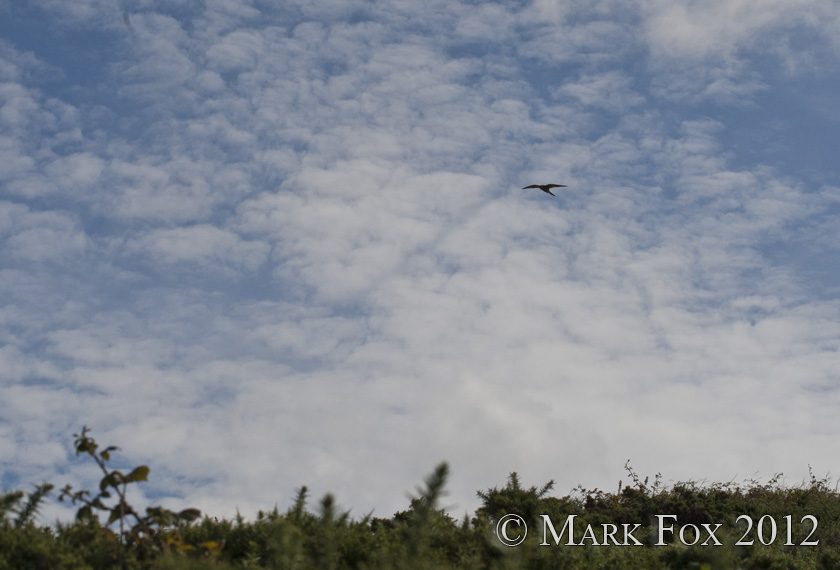

I tried to make the most of the minimal focal length by including the habitat in the shot. Looking back at the shots, I should have crouched lower and composed more gorse in the frame and tried to boarder the frame. But its a start and something I can improve on when working with a restrictive focal length.


To look at my other work, scroll to the 'older post' button on the bottom right.


Contact:
markfoxphoto@hotmail.co.uk
www.facebook.com/markfoxphotography

Sunday, 17 June 2012

Bristol Trip/exhibitions

For any of you locating my site, unfortunately it is down at the moment so I have linked the URL to my blog page.

I have had a great week or two, holding two exhibitions and helping out at the British Red Squirrel stand for the Festival of Nature.

From the 8th -13th June I had an exhibition in Bristol named 'Nature Exposed'. This was a showcase of work from the 'Marine and Natural History Photography' course that has just recently graduated from Falmouth university.

The exhibition was a great success with hundreds of people turning up, receiving a lot of positive feedback. We had been organising this exhibition for roughly 9months so having it going to plan was a big relief!


Starting from the 15th June, I have an exhibition with all of the graduates on the course with is held at the university in Falmouth which is still running, so if you are in the area - check it out!

After Nature Exposed was finished, I spent a couple more days in Bristol so I could help out at the Festival of Nature but before that I met up with Richard Brock who has worked in the BBC for 35years but left last year and now he makes his own conservation films. (www.brockinitiative.org) I have been in contact with him for a good couple of months now but it was great to finally meet him and talk about a subject we are both passionate about. My goal in life is to become a wildlife cameraman so if you are reading this and require a helping hand in anything relavent to this subject - drop me a line!

Last Saturday 16th June, I helped out at the British Red Squirrel stand at the Festival of Nature. This involved mainly educating the public about the threats and the struggle for survival  that the red squirrel faces. I had photo prints for sale too which generated interest, and I was fortunate enough to sell some too! (www.britishredsquirrel.org)


This was a very productive week talking to natural history film productions such as the BBC at the festival and I gain some great contacts!


To look at my other work, scroll to the 'older post' button on the bottom right.


Contact:
markfoxphoto@hotmail.co.uk
www.facebook.com/markfoxphotography


Sunday, 25 March 2012

Research: Green Lizard

A scary thought hit me that I am graduating in a couple of months and I will need to find a job to fund my wildlife photography. However, all I can think about is what wildlife to shoot this summer and what projects I want to do in the future!
After graduation I will move back to Jersey so I thought it would be good to start a project on Jerseys wildlife.
Jersey is home to some unique wildlife that may not be found anywhere else in Britain; The agile frog, lesser white-toothed shrew, the Jersey bank vole (a litter bigger than UK bank vole), green and wall lizards and also the red squirrel, which I have been working on all year.

I have been researching these species over the past couple of weeks now and today I decided to head to the west coast to see if I could find any green lizards. Although it isn't summer quite yet, the sun was shining so I thought I might have a chance of seeing them basking on rocks and metal sheets that have been placed on the ground for them.


Lizards are cold-blooded and therefore rely on heat from the sun or hot surfaces to digest their food and move around. Rocks and these metal sheets absorb heat from the sun, allowing it to stay warm for a long period of time. This is great for the lizards, because not only does it keep them warm but it gives them cover from predators like the populous Kestrels and Marsh Harriers.

Female Green Lizard
 

In total I found 4 green lizards in the area. When lifting the sheets of metal I made sure I placed it back where it was and the lizard was only exposed briefly.
 Come summer these Lizards will be a lot easier to photograph because they will be basking on rocks in the sun, so I won't be causing any disturbance.

Jersey is the only place is the whole of the British Isles where Green Lizards are native. However, they are increasingly under threat, for more information see the Jersey Green Lizard Project - www.greenlizard.org.je

Remember:
  • Always put the wildlife before yourself; if the wildlife appears agitated and scared - leave it alone.
  • Keep noise levels to a minimum
  • Do not overcrowd the species
  • Research the species before photographing it.

To look at my other work, scroll to the 'older post' button on the bottom right.


Contact:
markfoxphoto@hotmail.co.uk
www.facebook.com/markfoxphotography

Wednesday, 21 March 2012

Camera Slider


I went to my local Cornish woodland yesterday and tried out some video rail stuff. The contraption was put together using two pieces of 6ft PVC piping and another cut in half to act as the sliders. My mate, Sam Stewart built the slider and I went to try it out. There are a few alterations we need to do to improve the smoothness of the shot but for the first attempt I think it turned out pretty well.


Short video sequence:


Click the Youtube logo and it will relocate you to see it larger.


To look at my previous shoots, scroll to the 'older post' button on the bottom right.


Contact:
markfoxphoto@hotmail.co.uk
www.facebook.com/markfoxphotography


Tuesday, 20 March 2012

Support My Work


www.facebook.com/markfoxphotography 

Check out my facebook page, it holds a selection of my photographs in a portfolio style folder.
Aside from this, I post all of my updates on what I am up to and any other relevant information.

Through this page, you can ask me anything you want, whether it be about wildlife, a new camera you have got, any photographic tips in the field.. Tell me whatever you like and I will do my best to help you out!

It would be greatly appreciated if you could support my work.
If you have any friends you feel would like the page, share it to them. www.facebook.com/markfoxphotography


Thanks guys, speak soon

Mark


Contact:
markfoxphoto@hotmail.co.uk

Thursday, 23 February 2012

Squirrel Chase Sequence

Hello,

I have been super busy trying to get the shots I have planned.
Basically, I am planning a video about raising awareness of the red squirrel and how people can get squirrels into their garden and educating them on what is best to feed them etc.

This video is a short piece I have put together which will be in my final video. It displays a common behaviour of squirrels; when they chase each other, spiralling up and down the tree in order to gain dominance or a mate.

A chase between a male & female and between two males look pretty similar but you can usually tell when they the male finishes by mating with the female or it finishes when one male exits the scene.

Here is the edit, enjoy and let me know what you think!!!


Youtube link below for the option of having it in larger size
http://www.youtube.com/watch?v=GEU5FzHLACI

To look at my other work, scroll to the 'older post' button on the bottom right.


Contact:
markfoxphoto@hotmail.co.uk
www.facebook.com/markfoxphotography


Friday, 20 January 2012

Walk from Kynance Cove to Lizard Point

Last Friday I went out with professional photographer David Chapman to Kynance cove and then we walked along the coast to the Lizard point. This field trip was very informative and I learned a lot  about the geological structure and history about the place, as well as identifying species of plants and birds.

Here are a few shots that I took on the day;


Wheatear

Wheatear
Male Stonechat

Female Stonechat
Female Stonechat


Pair of Fulmar


Jackdaw


Contact:
markfoxphoto@hotmail.co.uk
www.facebook.com/markfoxphotography


Thursday, 19 January 2012

Red squirrel improvement

This edit features footage from day 3 in Scotland. Day 2 consisted of removing an old unnecessary feeder and thinking about where to place my hide.
I tried to incorporate more squirrel footage in this video and kept it shorter then the last video.


Hide and the feeder


Tips to take from the video:

  • Build a hide and commit to staying in it
  • Do not move out from the hide until wildlife has gone
  • Keep noise level as minimal as you can
  • Its Winter so wrap up warm to reduce distractions
  • Placing bait down is a great way of attracting wildlife
  • Be sure to research the subject thoroughly before photographing it


To look at the journey I took to get to Scotland, scroll to the 'older post' button on the bottom right.


Contact:
markfoxphoto@hotmail.co.uk
www.facebook.com/markfoxphotography

Tuesday, 17 January 2012

First contact with the red squirrels

Finally my first edit with my encounters of the red squirrel. This has taken me ages to edit due to technical aspects of the video, however, it is here and ready to watch.
This video edit is on my first day in Scotland filming the red squirrels. Like I said in my last videoblog, the rangers were called off site due to very strong winds so I was very weary about leaving. It took until the early afternoon to venture out. I had never been to this place before so it was a new experience for me. Nevertheless, my photographic instinct kicked in and this is what I got up to.
Wildlife was shot on Nikon d7000 and presenting was on gopro.

Not a bad hide!


I would be very grateful if you could leave any comments about the video. 


Tips to take from the video:

  • I wouldn't recommend going to a woodland in strong winds
  • A building makes a great hide when in the right place
  • If you can, avoid shooting through windows/glass as you lose quality and light
  • Standing outside, waiting without a hide won't benefit either yourself or the subject
  • Be aware, patient & quiet! 
  • Don't do anything to harm the subject 


To look at the journey I took to get to Scotland, scroll to the 'older post' button on the bottom right.


Contact:
markfoxphoto@hotmail.co.uk
www.facebook.com/markfoxphotography

Monday, 5 December 2011

Progression of the Brown Rat


I have been photographing a brown rat the past couple of days. Rats, like squirrels, are a member of the Rodentia family. So to get a break from squirrels, I decided to photograph rats and then apply what I learn to the red squirrels when I photograph them next week. The grey squirrels I have been shooting are far too tame to transfer the techniques I learned to the red squirrels. So instead, I decided to change to a subject that is still common but not as tame. The brown rat seemed a perfect choice.

I used a Nikon d7000 as opposed to the d200 to reduce the grain in my shots as appeared in my photos in the last post. My other factor was that it was too dark under the tree so I also used a pocket maglite to lighten the subject.
In these shots I wanted to show the rat within its environment.


There are a couple rats in the area so in future, I would like to capture some interaction between them and show more behaviour. It is just a learning curve and hopefully I will get the shots I want with time.
This will most probably be the last shoot I do on the rats before leaving to go home. As from next week I will be photographing Red Squirrels in Scotland and then in Jersey so stay tuned if you want to see some cute sots of red squirrels!

To look at my previous shoots, scroll to the 'older post' button on the bottom right.


Contact:
markfoxphoto@hotmail.co.uk
www.facebook.com/markfoxphotography

Saturday, 3 December 2011

Lundy Island - Grey Seals

After owning the goPro hd camera for a good six months, I thought I would show you some wildlife that the gopro has encountered. The first video that I have put together are the clips I took when I went to Lundy Island to swim with grey seals. It was my first time using the camera properly and i'm glad I could document it.
The dives consisted of two sessions, one in the morning, where I was about half a metre from one and the second was in the afternoon, where the seals came up and nibbled out fins. We were very unlucky with the visibility that day so the underwater footage could have been better..
Another problem I encountered was that the battery doesn't last very long in cold water so it died pretty quickly! Now I have an extra battery bacpac for double power so next time I won't miss anything! 


To look at my previous shoots, scroll to the 'older post' button on the bottom right.


Contact:
markfoxphoto@hotmail.co.uk
www.facebook.com/markfoxphotography

Friday, 2 December 2011

Brown Rat second Attempt

This morning I went on another shoot down at Swanpool, to photograph the Brown rat again.
The light was incredible this morning, but unfortunately doesn't show in these photos because the area is too shaded. The point of this shoot was to experiment with wide angle (fish eye). The day before I found regular routes that they take, I chose one of them and baited it with bread. My plan was that the rat would take this regular path, stumble across some food and then stop to eat it.

First of all, I took some, what I call 'safety shots' with the Nikon 70-200mm lens, to ensure I manage to capture something on the shoot. This is only my second attempt so I going to have a lot of trial and error.


Once the rat was familiar with the stock of bread I kept laying down, I placed a camera with a fish eye down. I attached my remote control, but I wasn't planning on using it just yet. I wanted to make sure that the rat wasn't spooked out by this new random object.  It took no time for it to adjust, so I started firing the shutter. 


The camera body I was using was the Nikon d200 and because it was so dark I had to increase the ISO but the d200 is renowned for a crap ISO so these pictures are really grainy. In future I am going to use a d7000 to reduce the grainy effect.
I am going to sort out a lighting system too so I can bring out the environment.


To look at my previous shoots, scroll to the 'older post' button on the bottom right.


Contact:
markfoxphoto@hotmail.co.uk
www.facebook.com/markfoxphotography

Thursday, 1 December 2011

Change of Species

As most of you are aware I am doing a major project on Squirrels. I will be producing a short documentary about my search to find Britain's rare red squirrel. I will highlight the key concerns contributing to their survival and amount of extensive work that it takes to maintain their existence in the UK.
Because I have been focusing so much on this project, I decided to photograph something else. I took a trip down to my local wildlife spot, Swanpool and photographed the Brown Rat.

The majority of people treat these animals as vermin, which is understandable, but observing their behaviour this morning made me change my opinion of them and I thought they were actually kind of cute.
This was my first shoot with the rats so I was mainly studying their behaviour and identifying the regular tracks that they take. Now I know this, I am thinking about using a wide angle to photograph them.
Here are some shots I took this morning of the Brown Rat:


To look at my previous shoots, scroll to the 'older post' button on the bottom right.


Contact:
markfoxphoto@hotmail.co.uk
www.facebook.com/markfoxphotography


Sunday, 27 November 2011

East Cornwall

Last Thursday I experience what it was like to photograph east Cornwall.  I am in my third and final year of my degree and it has taken me until now the explore east Cornwall. Previously, I have only travelled to the north, south and west Cornwall so the east was something new.
Anyway, I hopped on the train to Truro and then took a connecting train 45mins in the direction towards London. I arrived at my location, an estate in Bodmin. It was my first time at this place so first of all I walked for hours to get a feel of the place. It accommodates a variety of ancient woodland, not only the usual mix of British trees, but also rarer species such as the Plymouth pear. With this habitat, it inevitably thrives wildlife; Otters, Salmon, Owls, Buzzards, Pheasants, Kingfishers, Dippers, Owls, the usual garden birds and the occasional Robin.
I managed to find a couple dippers, dozens of Pheasants and few Salmon but unfortunately didn't get any great shots. However, one experience I shared was that I managed to get ridiculously close to a peculiar Robin. So I put down my 600mm and replaced it with the 16-85mm kit lens. As it was only a kit lens I couldn't focus very close to the subject so I had to pull back a bit, but this is what I got.
At the end is a short video showing the jist of the shoot, with clips of how I took the shots.
All the clips in the video were shot on a goPro hd camera.
Birds Eye View


Lanhydrock Graveyard


To look at my previous shoots, scroll to the 'older post' button on the bottom right.


Contact:
markfoxphoto@hotmail.co.uk
www.facebook.com/markfoxphotography


Saturday, 26 November 2011

Mammal Trapping

Early this morning I joined my eco society at uni and did some mammal trapping. The traps were only sized to trap things like Mice and Voles. With the abundance of traps set over night, allowed us to complete the survey with 1xWoodmice and 1x Bank Vole. After checking the traps we laid a transect at every 10m and placed a quadrat at each point to study the area for signs of field voles. 
This exercise was enjoyable and I learned a lot. I learned how to identify the different species of mice and voles, how to track them and also how to find out their gender.
These shots are nothing special but I had to document this experience. In the future, I want to try and photograph these species within their environment using the trapping method to locate them. 

Woodmouse

Retrieving the Mouse

A large male Woodmouse


Studying area for signs of field vole

To look at my previous shoots, scroll to the 'older post' button on the bottom right.

Tuesday, 22 November 2011

Recovering the Cache

 Squirrels are scatter hoarders; when they find food resources they cache them in secretive places for times when food is scarce. The competition between squirrels is very intense so when they bury their nuts they dig several dummy caches before hiding the nut. This way, the other squirrels find it hard to see where the stash is and steal it.
This is now my third shoot with these squirrels and I am beginning to capture behaviour of the squirrel. These photos are illustrating the process when a squirrel recovers its cache.
Let me know what you think, positive criticism is welcomed. Thank you for reading.
Click to enlarge:


To look at my previous shoots, scroll to the 'older post' button on the bottom right.

Contact:
markfoxphoto@hotmail.co.uk
www.facebook.com/markfoxphotography


Thursday, 17 November 2011

An Autumn Touch on the Grey Squirrel

Hello everyone, new day and a new post.
I went on another shoot earlier this week and have only just got round to blogging it. Like my last blog, my images to create a sense of place, by showing my subject in its environment. This shoot was primarily to capture a seasonal feel in my photographs. Looking back at my photos I saw that there was no clear signs of autumn, portraying more towards a winter mood. So this time I wanted to focus on the leaves that have dropped from the trees and incorporate it in with my subject, the grey squirrel. 
These shots still require a lot more room for improvement but at this stage I am only trying to put across my ideas rather than perfecting them. In the first shot I was trying to describe an autumn woodland, using the squirrel almost as a prop in the photo, rather than focusing the photograph solely on the animal.
It would be greatly appreciated if you'd let me know what you think
Hope you like the photos, click to enlarge.


Great Tit within the environment


To look at my previous shoot, scroll to the 'older post' button on the bottom right

Contact:
markfoxphoto@hotmail.co.uk
www.facebook.com/markfoxphotography